

You bought an Instant Pot because you want dinner to feel easier, not like a science project. A printable cooking-times chart helps with that. When you can glance at a single page and see “chicken breast, frozen: about 12 minutes” you stop second-guessing yourself and start cooking.
Below you’ll find a fridge-friendly cheat sheet you can print, plus beginner tips that keep food tender, help you avoid the burn warning, and make the whole pressure-cooking thing feel a lot less mysterious.
How Instant Pot timing really works (and why it feels “longer”)
The number you set is only the time at pressure. Your pot still needs time to heat up and build pressure first, and it needs time to release pressure at the end.
So a “10 minute” recipe often takes closer to 25 to 35 minutes total, depending on how full the pot is, how cold your ingredients are, and whether you do a quick release or natural release.
One simple rule that saves a lot of meals: when you’re unsure, set a slightly shorter cook time. If something needs more time, you can lock the lid back on and pressure cook for a few more minutes. If you overcook chicken breasts, you cannot go back.
Quick Release vs Natural Release (it changes texture more than you think)
Pressure release is not just a safety step. It’s part of the cooking.
Quick Release (QR) vents steam right away, stopping the cooking fast. Natural Release (NR) lets pressure drop on its own, which takes longer and keeps the food cooking gently as pressure falls.
Use QR when you want to protect texture and color, and NR when you want tenderness and less splatter. If a recipe says “10 minutes NR,” it usually means: wait 10 minutes, then finish with a careful quick release.
After a paragraph of theory, here’s the practical way many home cooks use it:
- Tender vegetables
- Seafood
- Rice and grains
- Dried beans
- Big roasts and braises
Printable Instant Pot cooking times chart (High Pressure)
These are general guidelines for High Pressure. Actual times change with thickness, how tightly packed the pot is, and personal preference. “Frozen” assumes the food is frozen solid, not just chilled.
A couple of quick notes before you print:
- Times below are the pressurized cook times only.
- “0 min” means you bring the pot to pressure, then immediately quick release.
- When in doubt, check doneness with a thermometer and add time in small steps.
| Food category | Portion / type | High Pressure (fresh) | High Pressure (frozen) | Release notes |
|---|---|---|---|---|
| Chicken | Boneless breast (1 to 1.5 in thick) | ~7 min | ~12 min | NR about 10 min helps stay juicy |
| Chicken | Bone-in breast (about 3 in thick) | ~12 min | ~25 min | NR recommended |
| Chicken | Boneless thigh | ~7 min | ~10 min | NR or short NR |
| Chicken | Bone-in thigh | ~9 min | ~14 min | NR recommended |
| Chicken | Cubes (about 1.5 in pieces) | ~4 min | ~5 min | QR usually |
| Chicken | Whole chicken (about 3 lb) | ~20 min | ~40 min | NR about 15 min |
| Beef / veal | Stew meat (1 to 2 in cubes) | ~18 min | ~28 min | NR recommended |
| Beef / veal | Chuck roast (about 3 lb) | ~45 min | ~60 min | NR for better texture |
| Beef / veal | Beef short ribs (about 3 lb) | ~45 min | ~60 min | NR about 10 min |
| Beef / veal | Brisket (about 2 lb) | ~75 min | ~90 min | NR about 20 min |
| Beef | Ground beef (1 lb) | ~4 to 5 min | n/a | Break up after, then sauté if needed |
| Pork | Boneless chops (about 1.5 in) | ~1 min | ~2 min | QR |
| Pork | Bone-in chops (about 1.5 in) | ~2 min | ~3 min | QR |
| Pork | Pork tenderloin (about 1.5 lb) | ~3 min | ~5 min | NR about 10 min |
| Pork | Pork loin roast (about 2 lb) | ~15 min | ~22 min | NR about 15 min |
| Pork | Pork shoulder, boneless (about 3 lb) | ~60 min | ~80 min | NR about 15 min |
| Pork | Pork shoulder, bone-in (about 4 lb) | ~70 min | ~90 min | NR about 20 min |
| Vegetables | Broccoli florets | 0 min | n/a | QR immediately |
| Vegetables | Asparagus (thin) | 0 min | n/a | QR immediately |
| Vegetables | Asparagus (thick) | ~1 min | n/a | QR |
| Vegetables | Beets (small) | ~12 min | n/a | QR |
| Vegetables | Beets (large) | ~15 min | n/a | QR |
| Grains / rice | White rice, long grain (1:1 water) | ~6 min | n/a | NR about 10 min |
| Grains / rice | Brown rice, long grain (about 1:1.25 water) | ~22 min | n/a | NR 10 to 15 min |
| Grains / rice | Quinoa (1:1 water) | ~1 min | n/a | QR |
| Grains / rice | Pearled barley (1:2 water) | ~20 min | n/a | NR recommended |
| Grains / rice | Rolled oats (about 1:1.5 water) | ~3 min | n/a | QR, and pot-in-pot is helpful |
| Legumes | Black beans, dried | ~30 min | n/a | NR about 20 min |
| Legumes | Black beans, soaked | ~10 min | n/a | NR |
| Legumes | Chickpeas, dried | ~50 min | n/a | NR about 10 min |
| Legumes | Chickpeas, soaked | ~20 min | n/a | NR |
| Legumes | Lentils (brown or green) | ~10 min | n/a | NR 5 to 10 min |
| Legumes | Pinto beans, dried | ~40 min | n/a | NR about 15 min |
| Legumes | Pinto beans, soaked | ~20 min | n/a | NR |
| Desserts | Cheesecake (typical 7 to 9 in pan) | ~50 to 60 min | n/a | NR to help it set |
| Desserts | Flan or custard (about 6 in pan) | ~8 to 10 min | n/a | QR carefully |
| Desserts | Cake (8 in pan, many mixes) | ~35 to 40 min | n/a | Often QR, then test center |
Make it printable (and actually useful on a weeknight)
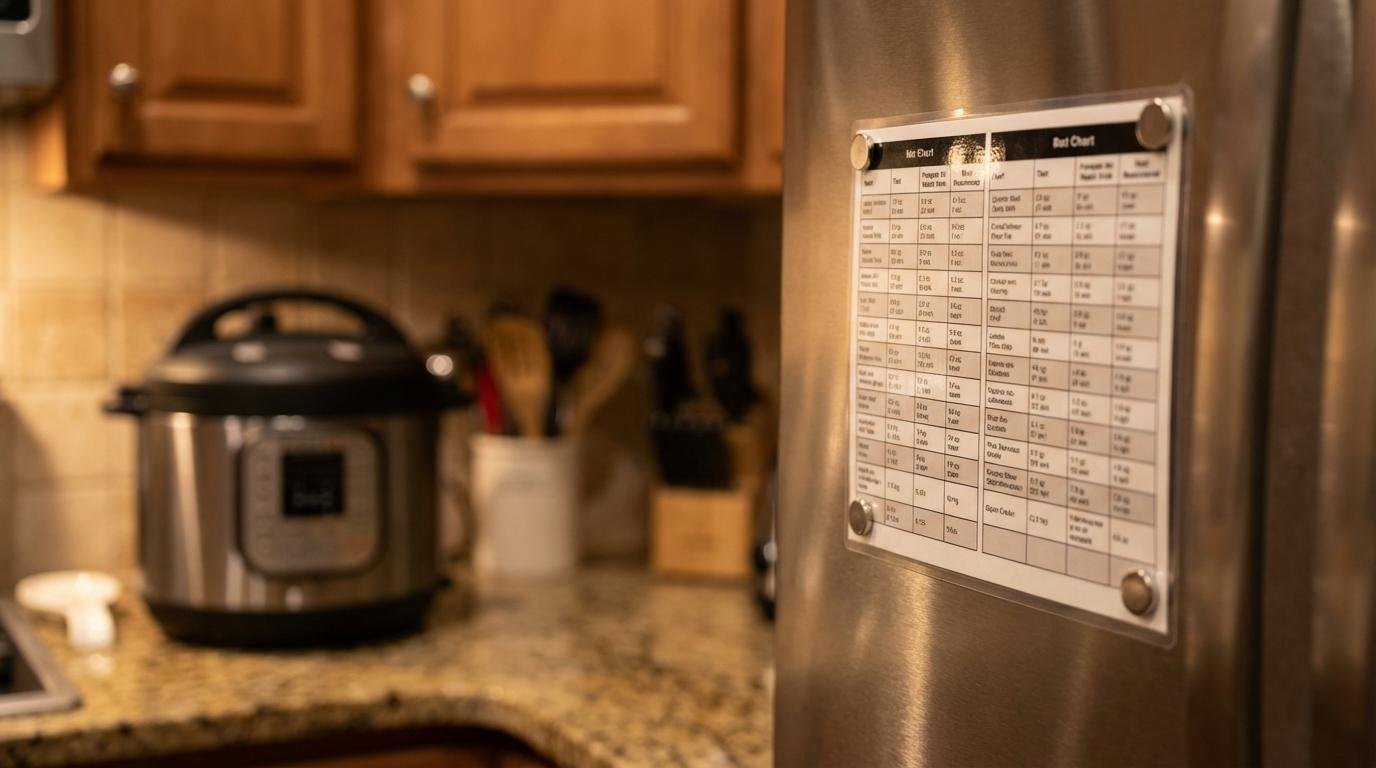
A “printable chart” is only helpful if it prints cleanly and you can read it fast. The easiest method is to copy the table into a doc, set the page to landscape, and keep it to one page.
If you want a chart that lasts longer than a week on the fridge, print it, then slip it into a sheet protector or laminate it. A dry-erase marker lets you jot notes like “our chicken breasts are huge, add 2 minutes.”
A few print tweaks that tend to work well:
- Landscape layout: Fits the table without tiny text
- Scale to 1 page wide: Keeps columns aligned and readable
- Bigger font (11 to 12 pt): Easier to scan while you’re cooking
- Paper choice: Regular paper is fine, cardstock holds up better
Beginner moves that prevent the burn warning
That burn message can feel personal, but it’s usually just physics: the bottom got too hot before enough liquid could circulate.
If you sauté onions or brown meat first, always deglaze. That means you add a splash of broth, water, or wine and scrape up the browned bits until the bottom of the pot feels smooth. Those browned bits taste great later, but they can trip the sensor if they stay stuck to the base.
Also, be cautious with thick sauces. Tomato-heavy sauces, very sugary sauces, and lots of flour or starch can scorch. A common trick is to add thin liquids first, then layer thicker ingredients on top and do not stir before pressure cooking. Stir after you open the lid.
If you love oatmeal, grits, or anything creamy, remember the pot-in-pot method. You cook the food in a smaller oven-safe bowl on a trivet with water underneath. It reduces sticking and cleanup, and it’s a gentle way to learn how your pot behaves.
Safety checks you can do in 10 seconds
Pressure cooking is safe when you treat steam like the serious thing it is: extremely hot, fast, and invisible right at the vent.
Before you press Start, do a quick scan. It becomes automatic after a few cooks, and it saves a lot of frustration.
- Sealing ring: Clean, seated flat, no cracks
- Steam release position: Set to Sealing for pressure cooking
- Fill level: Stay under the max line, and lower for foamy foods (beans, grains)
- Hands and face: Keep clear of the vent during quick release
- Doneness check: Use a thermometer, not vibes (poultry 165°F; steaks and roasts 145°F with a rest)
How to adjust times when your food is not “average”
Most charts assume average thickness. Real groceries rarely cooperate.
If your chicken breast is extra thick, the time needs to go up. If your pork chops are thin, 1 minute can be too much. When pieces are different sizes, the smallest pieces will overcook while the biggest finish.
A few friendly guidelines:
- Thickness beats weight for many cuts. Two chicken breasts that weigh the same can cook differently if one is thick and one is wide and thin.
- Frozen takes longer, and it also takes longer to come to pressure. Expect the total clock time to stretch.
- Big roasts like patience. Natural release is often where the tenderness happens.
- Beans get better with NR. Quick releasing a pot of beans can cause sputtering and broken skins.
If something is underdone after you open the lid, you’re still in a great spot. Add a small splash of liquid if needed, lock the lid, and cook 2 to 5 minutes more. That “extra cycle” trick is one of the easiest ways to get consistent results while you’re learning.
A few easy practice cooks (so the chart starts making sense)
If you’re new, pick cooks that are forgiving and repeatable. Meal Magic readers often like starting with plain rice, shredded chicken for tacos, or a simple bean soup.
Try one skill at a time:
- Practice coming to pressure and doing a controlled quick release with vegetables.
- Practice a 10 minute natural release with rice or chicken.
- Practice sauté plus deglaze, then pressure cook, with chili or a simple stew.
Keep your printable chart nearby, then add your own notes in the margins. After a few dinners, it stops being a “cheat sheet” and turns into your personal playbook.
